


Media Release
Date: 26 January 2026
RUH supports world’s largest-ever Parkinson’s disease research study
Researchers at the Royal United Hospitals Bath NHS Foundation Trust are recruiting to the world’s largest-ever clinical trial of treatments to slow or stop the progression of Parkinson’s disease.
Recruitment is now underway to the Edmond J Safra Accelerating Clinical Trials for Parkinson’s Disease (EJS ACT-PD) trial. EJS ACT-PD is helping to accelerate the search for effective treatments for Parkinson’s with an innovative trial design which tests multiple treatments in parallel.
Parkinson’s disease is one of the world’s fastest growing neurological conditions, with 166,000 people affected in the UK today. Parkinson’s gets progressively worse and although there are treatments that can help with symptoms, these become less effective over time, meaning there is an urgent need to find treatments that can slow or stop the disease progression.
Initially, the trial will be testing two drugs known to be safe and effective at treating other conditions: a blood pressure medication and a drug used to treat an enlarged prostate.
One of the first people to volunteer for the trial at the RUH was Pete Sinclair, 70, from Chilcompton.
Pete was first diagnosed with Parkinson’s in 2020 when he noticed a problem while he was out walking.
“I’d noticed that I’d begun to start dragging my foot while walking and my left arm would hang by my side,” he said.
“Then one evening I was eating and couldn’t hold my knife and fork properly.”
Pete went to his GP and spoke to a neurologist, who sent him for scans at the RUH to rule out the possibility of a brain tumour.
“The scan didn’t show a tumour but there were enough clues for the doctors to think it was Parkinson’s.
“I was put on medication straight away which has really helped me, but as there’s no cure for this condition, I’ve been keen to take part in any trials that could identify ways to slow the progression.
“So when I found out about the EJS ACT-PD trial at the RUH I signed up straight away. It might help me now, but even if it doesn’t it will hopefully help to make a difference to other people in the future.
“I think taking part in research like this is so important – you really are playing an important role in finding treatments for conditions that could make such a vital difference to people in years to come.
“The team at the RUH have been great, so helpful and supportive. They’ve explained everything very clearly to me and answered all my questions. I can’t wait to get started now!”
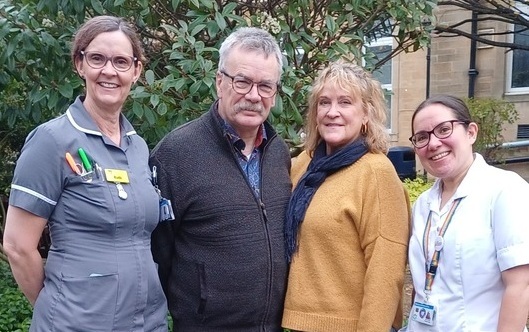
Ruth Blackman, Research Nurse, said: “I’m delighted that the RUH is recruiting to such an important study.
“By testing new drugs for this condition, we’re hoping to find new treatments that will slow or perhaps even stop progression of Parkinson’s.”
Vicky Page, Clinical Research Practitioner, said: “We’re really excited to have been one of the first sites in the UK to open this innovative trial and I look forward to supporting other sites in our region to deliver it in the future.”
If you have been diagnosed with Parkinson’s and would like to take part in the EJS ACT-PD study, please contact the RUH Parkinson’s Research team via
ruh-tr.researchopu@nhs.net or by calling 01225 825797.
People with Parkinson’s can also register their interest in participating using a simple online form.
The EJS ACT-PD trial is being led by researchers at University College London (UCL) and Newcastle University. It’s sponsored by UCL and funded by a Medical Research Council (MRC) and National Institute for Health and Care Research (NIHR) partnership, Cure Parkinson’s, The Michael J. Fox Foundation, Parkinson’s UK, The John Black Charitable Foundation, The Gatsby Charitable Foundation and Van Andel Institute.
ENDS