


Media Release
Date: 2 July 2026
The RUH supports pioneering research to improve early diagnosis of endometriosis
The Royal United Hospitals (RUH) Bath NHS Foundation Trust has supported promising earlystage research aimed at improving how endometriosis is diagnosed.
Endometriosis affects around 1 in 10 women and people with a uterus in the UK, yet diagnosis takes eight – nine years on average. Currently, confirmation often requires a laparoscopy (keyhole surgery), as MRI and ultrasounds scans can struggle to identify the most common forms of the condition in its earlier stages.
RUH staff contributed to the pilot DETECT study, led by the University of Oxford and supported by Serac Healthcare, which explored whether a new imaging technique could help detect endometriosis earlier and reduce the need for diagnostic surgery.
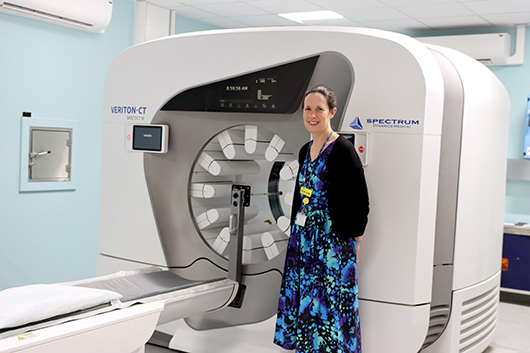
The RUH – which is part of BSW Hospitals Group – was invited to take part in the study due to its state-of-the-art SPECT-CT scanner and the team's expertise in using this technology. This meant that all 19 study participants had their scans carried out at the RUH.
Staff at the RUH designed, developed and reviewed the study scans, and advised on using the technology. The tests investigated whether an experimental tracer called 99mTc-maraciclatide could detect new blood vessel growth on the CT scan, as this is a feature often associated with early-stage endometriosis.
Sarah Cade, Head of Medical Physics and Bioengineering at the RUH, said: "We were pleased to support this important early-stage research. By designing and developing a tailored scanning protocol, we were able to explore whether this technology could help identify endometriosis in a different way. While further research is needed, the early findings are encouraging."
The scans undertaken at the RUH were found to align well with the surgeons' findings during planned diagnostic surgery. This suggests that the new scanning technique could, in the future, support earlier diagnosis of endometriosis.
Professor Krina Zondervan, Head of Department at the Nuffield Department of Women's and Reproductive Health at the University of Oxford, said: "The most prevalent subtype of endometriosis currently evades reliable detection, leaving women no choice for diagnosis other than invasive surgery. If these results are confirmed in larger phase 3 studies, imaging with maraciclatide could transform clinical research and practice and potentially empower the development of treatments for women across the globe."
Professor Richard Graham, Research and Development Director for BSW Hospitals Group, Consultant Radiologist at the RUH and a coauthor of the study, said: "We are delighted to have been invited to take part in this important pilot study.
"Research is extremely important to all hospitals in BSW Hospitals Group, and evidence shows that patients treated in research-active hospitals have better outcomes, even if they are not participating in a study. The RUH is also one of the most research active hospitals of its size in the UK, something we are very proud of.
"Being part of the DETECT study reflects our commitment to research that benefits our wider community and to working in partnership with academic colleagues. We are also pleased to be supporting research that aims to improve women's health."
This is very early stage research and further studies are planned to confirm the effectiveness of the research and determine whether it can be introduced more widely. David Hail, CEO of Serac Healthcare, said: "With FDA Fast Track Designation and agreed Phase III study designs, we are now advancing to validate these findings in larger trials and progress to regulatory submission."
This means that, while the scan is not currently part of NHS care, the findings so far represent an important step towards reducing delays in diagnosis and in helping people affected by endometriosis access answers, support and care sooner.
The study is not currently seeking new participants.
ENDS